


dunno the accusatives & possessives, but if I follow middle English’s gendered pronouns, we could use:
a/am/as
or
a/ar/ars
e.g.
I think a is very nice.
I met am/ar recently.
Is this as/ars dog?
A told me that the house is as/ars.
A said a would rather do it aself.
What do you think?
Reminds me of:
他, 她, 它 (ㄊㄚ, tā)
Optional title:
when you learn time is a flat circle
Is it literally just the letter a?
Correct. I was researching if Middle English Speakers had accusatives & possessives transformations for “a,” but I couldn’t find any of the available papers alive if they had any transformations whatsoever. I am trying to see if we can make our own, or stick to David Lindsay’s ae/aer (1920), or Francis Augustus Brewster’s e/em/es (1841).
“Ou” doesn’t fit right with modern “We/us/our”
I’m definitely familiar with US English speakers who say something more like “ah’ve” than “i’ve”.
that’s actually natural. but I was looking for 3rd person singular [unknown gender] pronouns to replace Francis Augustus Brewster’s e/em/es (1841), to find out Middle English speakers already had.
Ah, my brain read the first definition and totally forgot you put 3rd person in the title and failed to see the following definitions. Oops.
It’s alright. I still want your input:
- a/am/as
- a/ar/ars
- ae/aer
- e/em/es
- they/them
- [insert your own]
I’m fine with singular they, personally, but as a cis-het guy, I’m not sure I’m the most qualified to be speaking on the subject, heh.
If something shorter was desired, maybe
y(pronounced more like/i/) like french uses in another context that otherwise never stands alone in English and shouldn’t really be homophonic with anything else meaningful when usage is considered.So “e/em/es,” (4) or french “J’y” (6)? Does french “y” have accusative or possessive transformations, or is it combinational?
French ‘y’ is like ‘there’ in English, roughly (IIRC; it’s been decades). But, since English doesn’t use it, it doesn’t matter. Presumably, it would take a normal
'sfor possession. I don’t know about accusative or dative.So, something like y/y/y’s: e.g.
I think y is very nice.
I met y recently.
Is this y’s dog?
Y told me that the house is y’s.
Y said y would rather do it yself.
📝
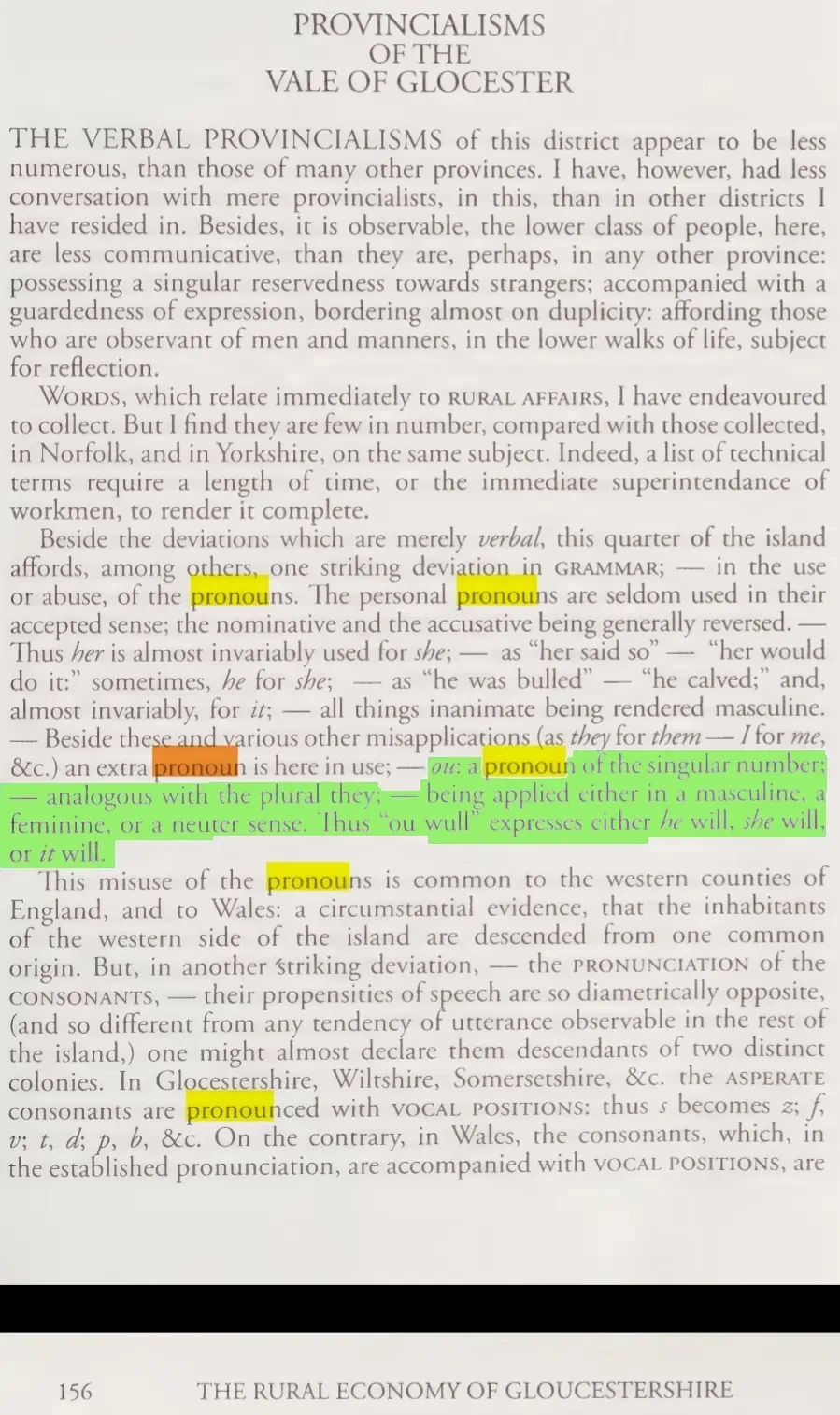
🔍 Marshall, W. [1789] 1873-74. Rural economy of Glocestershire. Reprinted as Provincialisms of the vale of Gloucester. Publication of the English Dialect Society, no. 2, 55-60. London: Truebner.After reading the reference, page 155 ¶3, it doesn’t note “a,” but “Ou” and used as singular “They.”
what are the verb conjugations to go with these pronouns? I think Wiktionary might have them…
Spoilers for The Long Earth series
What about First Person Singular?
Thanks for the rabbit hole. Requesting those book from my local library.

